Accelerate Software Releases in Japan: A Step-by-Step IT Modernization Guide
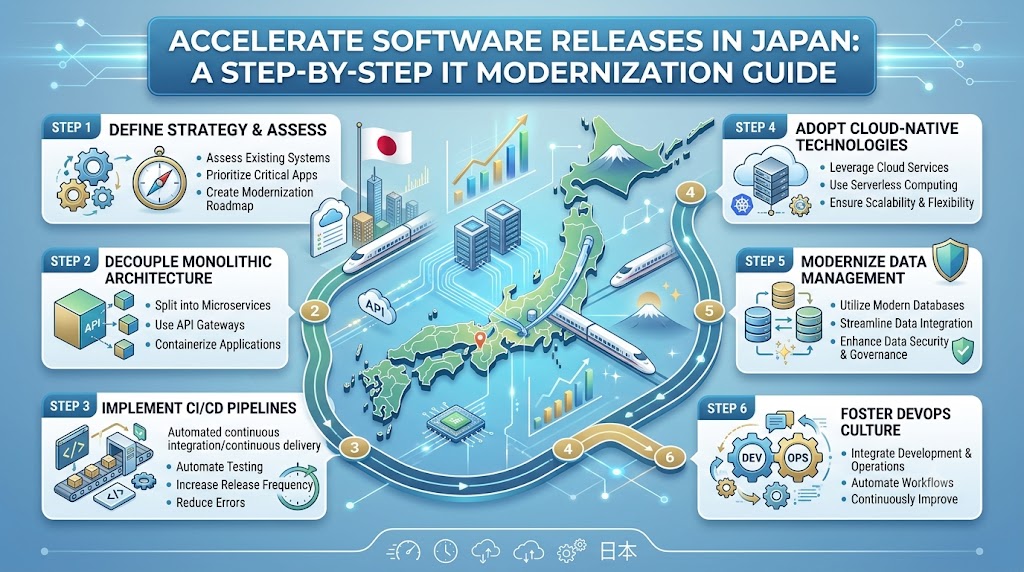
Today, companies must update their digital tools fast to stay ahead in business. Many engineering teams in Japan want to ship software quickly, but they face a big shortage of skilled engineers. Moving away from slow, manual steps toward modern cloud systems can feel very confusing. Teams often feel lost when choosing tools for cloud servers, code testing, and daily operations. Because every business wants smooth apps that never crash, leaders need a clear plan to upskill their people. Learning modern engineering practices turns hard tasks into simple routines. Working with an experienced advisory partner like DevOpsSchool.jp helps teams build these skills step by step. With the right roadmap, your developers and operations staff can learn modern methods, reduce mistakes, and deliver top-quality software with real confidence every single day.
What is DevOpsSchool.jp?
DevOpsSchool.jp is a dedicated platform that helps teams in Japan master modern software engineering. It offers structured programs for companies that want practical, hands-on growth. The platform does not just teach basic theory from books. Instead, it lets engineers practice on real cloud labs.
Teams learn how to automate daily tasks, write clean infrastructure code, and fix live production bugs. DevOpsSchool.jp also provides expert advisory help. This means specialists guide your managers through big tech changes. Whether your company needs short boot camps or long-term technical help, the platform builds a custom learning path for your exact goals.
Building Strong Internal Engineering Skills
Many engineering groups still spend days testing code by hand. When people do manual work, mistakes happen often. Software bugs slip into production, and releases get delayed. Structured training solves this pain point quickly. It gives your staff safe sandbox labs to practice automation every day.
Enrolling your team in a dedicated DevOps 研修 helps developers and system admins share the same goals. They learn how to write code, test it automatically, and deploy updates in minutes.
[Write Code] ➔ [Automate Tests] ➔ [Fast Cloud Release] ➔ [Happy Users]
When companies invest in targeted DevOps corporate training Japan, their teams make fewer errors. Work becomes predictable, team stress drops, and your business delivers value much faster.
Hands-On Expert Guidance for Transformations
Adopting new delivery habits is not only about downloading modern software tools. It also requires teams to change how they talk and plan. Many companies struggle during this change because old habits die hard. Having an outside specialist guide your managers makes the entire journey much smoother.
Through professional DevOps コンサルティング, senior advisers review your current delivery pipelines. They spot slow bottlenecks, point out security gaps, and design simpler workflows.
Working with a trusted DevOps consultant Japan gives your engineering leaders direct answers to tough problems. These advisers help your staff avoid costly rework, pick the right cloud setup, and hit project goals without panic.
Mastering Cloud-Native Infrastructure Tools
Modern applications run best when split into small, manageable pieces called containers. Think of a container as a tiny digital lunchbox. It holds all parts of a program so it runs smoothly on any computer.
Managing hundreds of these digital containers by hand is impossible. That is why companies send their staff to a Kubernetes 研修. This program teaches engineers how to start, scale, and balance containers automatically across cloud servers.
Next, teams need to create servers without clicking buttons in web portals. A specialized Terraform 研修 teaches engineers to define servers using simple text files. When your infrastructure is written as code, you can build identical, safe environments in seconds.
Ensuring System Reliability and Uptime
When an online service goes down, customers get upset and businesses lose money immediately. Modern companies cannot wait for angry customer calls to find out an app is broken. Site reliability engineering teaches teams how to protect uptime using data and smart metrics.
Taking an active SRE 研修 teaches your operations staff to monitor response times, track error budgets, and set up clear alerts. Your engineers learn how to study logs, spot early warning signs, and fix memory leaks before users notice. As a result, your apps stay online, fast, and stable around the clock.
Integrating Security into Daily Delivery
In traditional IT setups, security audits happen at the very end of a project. If inspectors find a big security flaw right before launch, the whole release stops. Developers must rewrite code, deadlines get missed, and project costs jump.
A modern DevSecOps 研修 teaches teams to shift security checks directly into daily coding routines. Automated security scanners test every code pull request as soon as a programmer saves it.
[Write Code] ➔ [Auto-Scan for Vulnerabilities] ➔ [Instant Fix] ➔ [Safe Release]
This simple habit keeps codebases clean. It protects sensitive user data without slowing down your weekly feature releases.
Scaling AI and Machine Learning Pipelines
Many enterprises build exciting artificial intelligence and machine learning models in research labs. But moving those models onto live internet servers is very hard. Machine learning code relies on changing data, complex dependencies, and heavy computing hardware.
A practical MLOps 研修 shows engineers how to automate machine learning pipelines from start to finish. Teams learn to package models, run automated tests, and track accuracy changes over time. If a live model starts giving bad answers, automated tools redeploy an earlier safe version. This practice keeps business AI reliable, fast, and simple to manage.
Continuous Technical Assistance for Enterprise Teams
Even the best-trained teams run into rare system bugs or unusual cloud errors. In those tough moments, searching public forums takes too much time and risks production downtime. Having on-demand expert backup gives your technical leads true peace of mind.
With dedicated DevOps support Japan, your engineers get fast help with complex configuration files, tricky deployment scripts, and unexpected outages. Experienced specialists join your screen shares, review pull requests, and explain root causes clearly. This ongoing backup ensures your digital operations run smoothly every week.
Real-Life Scenarios and Team Experiences
- Moving Away from Manual Virtual Machines: A financial IT department spent two days configuring servers for every release. After learning container orchestration, they automated deployments into repeatable scripts, cutting launch time down to thirty minutes.
- Fixing Friday Release Panics: A retail software team often worked late on weekends to fix broken production releases. By building automated continuous testing pipelines, they caught code errors before launch and now deploy updates safely during normal business hours.
- Eliminating Surprise Cloud Outages: An online service group experienced unexpected downtime during monthly flash sales. After adopting site reliability habits, they set up automatic alerts and traffic limits that stopped crashes completely.
Common Mistakes to Avoid in Tech Transformations
- Buying Expensive Tools Before Training Staff: Software licenses do not solve delivery problems if your engineers do not know how to configure them properly.
- Skipping Hands-On Practice Labs: Reading slide decks never builds true technical skill; engineers need sandbox environments to break and fix systems.
- Leaving Security Checks for the Final Week: Finding critical bugs right before launch delays releases and causes huge friction between teams.
- Ignoring Observability and Logging: If you do not monitor app health metrics, your customers become your primary bug reporters.
- Attempting to Automate Everything on Day One: Trying to fix every manual step at once overwhelms engineers and creates unnecessary confusion.
- Isolating Developers from Operations Staff: Keeping teams in separate silos prevents shared ownership of app speed and system uptime.
- Copying Other Companies Without a Clear Plan: Every business has unique needs, so blindly copying someone else's toolchain creates messy complexity.
- Treating Transformation as a One-Time Project: Modern engineering requires continuous practice, routine skill updates, and ongoing team support.
How DevOpsSchool.jp Can Help
DevOpsSchool.jp works hand in hand with enterprise teams to build practical, long-term engineering capability. The platform provides customized corporate roadmaps designed around your current tech stack. Instructors are industry veterans who share real-world advice rather than dry textbook theory.
Engineers work inside active cloud sandboxes where they can safely test code, run containers, and manage infrastructure files. Whether your company wants to upskill a small platform squad or modernize an entire division, DevOpsSchool.jp offers flexible schedules, direct mentor Q&A, and trusted advisory guidance.
A Simple 7-Step Upskilling & Advisory Roadmap
Follow this clear process to modernize your engineering organization:
[1. Goal] ➔ [2. Search] ➔ [3. Shortlist] ➔ [4. Compare] ➔ [5. Ask] ➔ [6. Verify] ➔ [7. Decide]
- Goal: Identify your biggest pain point, such as slow releases, manual errors, or frequent system downtime.
- Search: Look for established training and consulting providers with a proven enterprise presence in Japan.
- Shortlist: Select two or three programs that offer hands-on cloud labs and experienced technical instructors.
- Compare: Review class outlines, lab setups, instructor backgrounds, and post-training support options side by side.
- Ask: Speak directly with course advisers to discuss your team's current technical level and tool stack.
- Verify: Check real enterprise reviews, verify instructor credentials, and inspect sandbox lab access policies.
- Decide: Choose the best program, confirm the custom schedule, and start your team's upskilling journey.
Frequently Asked Questions (FAQ)
Question 1: What is the main goal of modern DevOps training?
The primary goal is to help your developers and operations staff work together smoothly. They learn to automate repetitive manual tasks, test application code quickly, and deploy software updates without costly errors. This teamwork shortens development cycles, keeps cloud systems reliable, and allows your company to deliver useful digital features to your customers on time.
Question 2: Why do enterprise teams in Japan need specialized cloud training?
Many enterprises in Japan are modernizing legacy computer systems to stay competitive. However, finding experienced cloud engineers is tough due to talent shortages. Tailored corporate programs solve this challenge by upskilling your existing staff in place. Your internal engineers already understand your business rules, so teaching them modern cloud tools produces fast, dependable results.
Question 3: How long does a typical corporate technical training program take?
Most targeted corporate workshops run between two and five intensive days. Some organizations prefer spreading sessions across several weeks so staff can balance learning with daily work. High-quality programs give engineers ongoing access to cloud sandbox labs after class ends, letting them practice techniques thoroughly until they feel confident on production systems.
Question 4: Can non-cloud teams learn container orchestration tools easily?
Yes, any engineer with basic Linux and networking knowledge can learn container tools. Quality training breaks down complex topics into simple concepts. Instructors start by explaining basic application packaging before moving on to multi-server container management. With dedicated practice inside guided labs, traditional system administrators quickly master modern container commands and deployment routines.
Question 5: How does infrastructure as code prevent human errors?
Setting up cloud servers by clicking buttons in web portals often leads to forgotten settings and inconsistent configurations. Infrastructure as code lets engineers write server specifications inside simple text files. These files are tested automatically and stored in version control. This ensures every environment is identical, easy to audit, and simple to recreate within minutes.
Question 6: What is the difference between consulting and corporate training?
Training focuses on teaching your employees new technical skills through lectures, guided demonstrations, and hands-on labs. Consulting brings outside specialists into your company to analyze your workflows, solve complex technical roadblocks, and design long-term cloud architectures. Many enterprises combine both services so their teams learn new skills while experts ensure their architecture stays solid.
Question 7: Why is site reliability engineering important for online businesses?
Site reliability engineering keeps critical internet platforms running smoothly without unexpected service outages. It replaces emotional guesses with real operational data, error budgets, and health metrics. Operations staff learn to detect performance problems early, automate recovery actions, and conduct blameless reviews after incidents, ensuring your business protects its brand reputation and avoids revenue loss.
Question 8: How does shifting security early help our software releases?
Traditional audits happen at the end of development, often catching big security flaws right before release day. This creates urgent, stressful rework and delays product launches. Shifting security early introduces automated vulnerability checks into daily code commits. Developers fix flaws while writing code, keeping the application secure throughout development without slowing release schedules.
Question 9: What business value does machine learning operations provide?
Machine learning models require clean data, regular retraining, and active system monitoring to remain useful. Without automation, data scientists spend days updating models manually on production servers. Modern machine learning operations automate data testing, packaging, and deployment. This allows your enterprise to scale its artificial intelligence services reliably while preventing model degradation over time.
Question 10: How do we choose the right technical training partner?
Look for partners that offer extensive hands-on labs rather than slide-only lectures. Ensure their trainers have genuine field experience managing enterprise cloud systems. A reliable partner will customize training topics around your current software tools, respect your project timeline, and offer follow-up support so your engineers can ask questions as they build real systems.
Question 11: Can these modern delivery practices work with legacy architectures?
Yes, you can introduce modern delivery practices to legacy systems gradually. Teams do not need to rewrite their entire codebase at once. You can start by automating basic code testing and server setup steps. Once those routines are stable, you can package parts of the application into containers, modernizing your infrastructure step by step safely.
Question 12: What type of ongoing support helps teams after training finishes?
Helpful post-training support includes access to private community channels, mentor Q&A sessions, code reviews, and architecture check-ins. When engineers hit unexpected bugs on real company projects, having access to experienced advisers saves hours of frustration. This continuous guidance reinforces new habits and ensures your staff applies modern practices correctly across all projects.
Conclusion
Modernizing your enterprise software delivery does not have to feel overwhelming for your engineering department. By focusing on practical, hands-on learning, your staff can master the tools needed to build, test, and release code quickly. Investing in solid automation foundations, adopting site reliability practices, and integrating security checks into daily tasks prevents costly downtime and keeps your systems safe. Choosing an experienced training and consulting partner like DevOpsSchool.jp ensures your teams gain real skills that last. With clear roadmaps, safe sandbox labs, and continuous expert support, your company can build strong engineering capabilities and thrive in today's fast-moving digital world.